

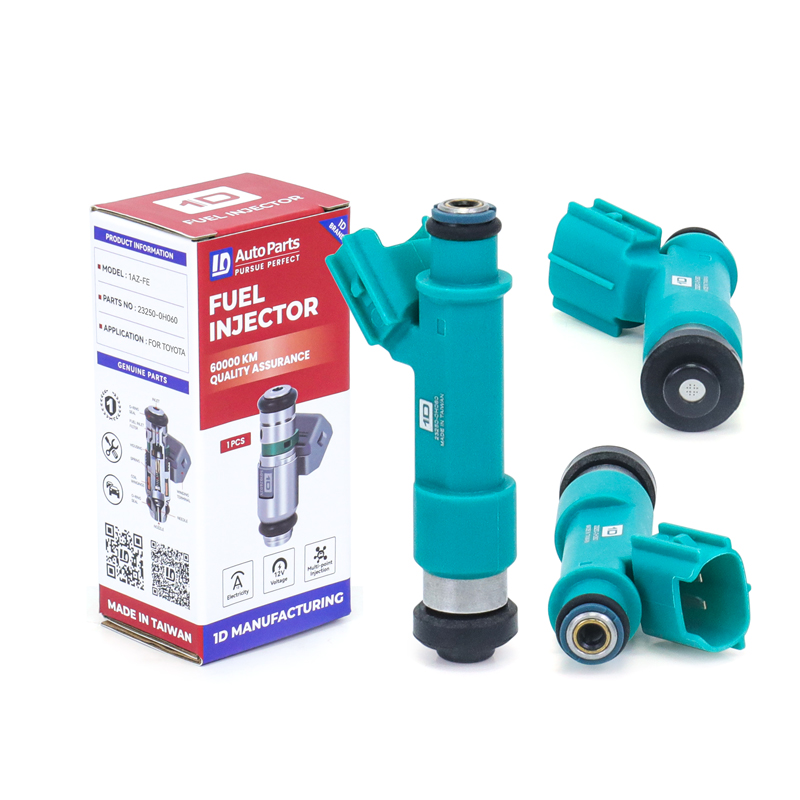
The fuel injector of a car is a simple solenoid valve. When the electromagnetic coil is energized, it generates a suction force, the needle valve is lifted, and the spray hole is opened. The fuel is sprayed out at high speed through the annular gap between the shaft needle at the head of the needle valve and the spray hole, forming a mist, which is conducive to complete combustion.
Fuel injectors are divided into high-resistance fuel injectors and low-resistance fuel injectors.
According to the coil resistance value, the high resistance is 13 to 16Ω and the low resistance is 2 to 3Ω.
High-resistance fuel injectors can only be driven by voltage, while low-resistance fuel injectors can be driven by both voltage and current.
? Current drive characteristics:
There is no additional resistance, the circuit impedance is small, the needle valve opens quickly, the fuel injection lag time of the fuel injector is shortened, and the response is good.
? Voltage-driven characteristics:
The fuel injection lag time is relatively long.
How often should fuel injectors be cleaned?
There is no fixed answer to the cleaning interval of fuel injectors. The fuel injectors are not consumable parts. If the vehicle starts at idle speed normally, there is no need to clean them.
Fuel injectors are precision products, including various types such as multi-point electronic fuel injection, single-point electronic fuel injection, and direct fuel injection. Generally, it is recommended to use something similar to additives to maintain the cleanliness of fuel injectors on a daily basis. If disassembly and cleaning are carried out improperly, it may have some impact on subsequent assembly.
When it comes to actual maintenance, many experienced mechanics would suggest this: For car owners who love their vehicles very much and are willing to spend money, have them cleaned every 20,000 kilometers. For ordinary car owners, once every 30,000 kilometers. For vehicles in good condition and with high-quality fuel, it is recommended to clean them once every 40,000 to 60,000 kilometers.
The environment where the nozzle is located is prone to carbon deposits. Some carbon deposits will adhere to the nozzle head, causing nozzle blockage or poor nozzle closure. Sometimes, it affects the injection Angle, resulting in poor atomization of gasoline. After the above situations occur, it will affect the quality of the mixture, and the consequence is that more carbon deposits will be formed, thus creating a vicious cycle. This plays a fundamental role in the power performance of each engine.
Due to poor fuel quality, the fuel injectors are not working properly, resulting in severe carbon deposits in the cylinders. The cylinder barrel and piston rings wear out at an accelerated rate, causing unstable idle speed, increased fuel consumption, weak acceleration, difficult starting and excessive emissions. In severe cases, it may completely clog the fuel injectors and damage the engine.
Therefore, it is necessary to clean the fuel injectors regularly. Long-term failure to clean or frequent cleaning of the nozzles will have adverse effects.

How often does it need to be replaced?
Under normal circumstances, fuel injectors do not need to be replaced. Even if they are clogged with carbon deposits, they only need to be cleaned.
The hazards of not cleaning fuel injectors
1. The environment where the fuel injector is located is prone to carbon deposits. Some carbon deposits may adhere to the nozzle head, causing nozzle blockage or poor nozzle closure. Sometimes, it can affect the injection Angle, resulting in poor atomization of gasoline and carbon deposits.
2. Due to poor fuel quality, the fuel injectors did not work properly, resulting in severe carbon deposits in the cylinders. Accelerated wear of the cylinder barrel and piston rings can lead to unstable idle speed, increased fuel consumption, weak acceleration, difficult starting and excessive emissions, seriously clogging the fuel injectors and damaging the engine.
Note: Nozzle cleaning is also not regular. When cleaning is needed, do not be careless. When conducting maintenance, the technician should be reminded to pay attention to the use of the engine. Any problems should be dealt with promptly to avoid greater losses.